Connect with us

Sciences et technologie

NATEG Technology Day

insatpress

Published

on

[simplicity-save-for-later]

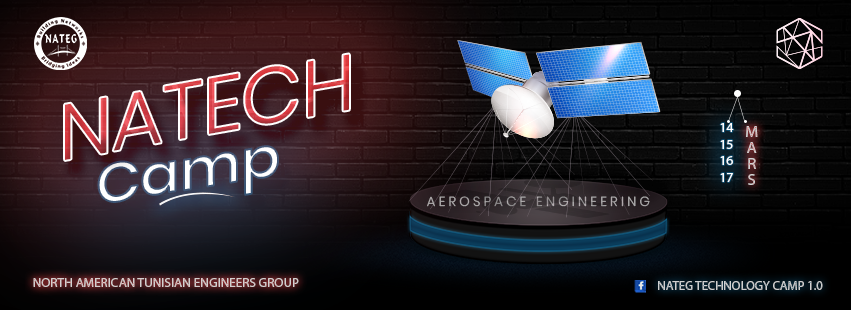
Après deux éditions qui ont connues un franc succès du fameux NATEG Technology Day et une édition reconnue par des résultats spectaculaires du brillant Spring Camp, l’association NATEG Tunisie est de retour pour cette année avec l’événement NATEG Technology Camp (NATECH CAMP) qui est une fusion entre NATEG Technology Day et Spring Camp

Ouvert à tous, la première édition de cet évènement se tiendra le 14-15-16-17 Mars 2022 à hôtel VINCCI MARILLIA HAMMAMET sous un thème de l’actualité : « L’ingénierie aérospatiale ».

NATEG Technology Camp est un événement de 4 jours qui va réunir, pour sa première édition, plus de 300 participants dont la majorité sont des élèves ingénieurs de toute la Tunisie, ainsi que des chefs d’entreprises et des experts de la Tunisie et de l’Amérique du Nord. 

En effet, cet évènement est l’occasion incontournable offerte aux étudiants, jeunes ingénieurs et entrepreneurs pour collaborer et aboutir à un changement significatif dans l’industrie tunisienne. 

Cette année, la première édition du NATECH CAMP sera tout à fait spéciale. Soyez au rendez-vous pour une expérience inédite et une rencontre enrichissante !

Le thème de l’évènement sera encore plus discuté par des conférenciers de haut calibre autour de deux tables rondes qui porteront sur “L’ingénierie Aérospatiale dans le monde” et “L’ingénierie Aérospatiale en Tunisie”.

Entre-temps, la journée sera rythmée par des workshops variés animés par les entreprises, des formations assurées par des experts et portant sur les « soft skills », et qui ont pour but d’améliorer les compétences managériales et communicationnelles chez les élèves-ingénieurs. 

Il y aura notamment des activités de réseautage afin d’assurer l’interaction entre les participants qui font partie ou non du mouvement, les entreprises et les experts présents dans l’événement.

Finalement, Il y aura un hackathon pour les participants et dont le challenge est de trouver des solutions répondant aux problèmes mentionnés dans les cahiers de charge proposés par nos chers sponsors. 

NATECH CAMP comporte quatre sous compétitions liées à « L’ingénierie aérospatiale » et qui nécessitent des connaissances en : SolidWorks, Internet des objets (IOT) et l’intelligence artificielle (IA). 

Alors c’est quoi l’ingénierie aérospatiale et pourquoi représente-elle une véritable révolution ? 

L’aérospatial est une discipline scientifique qui rassemble les techniques de l’aéronautique et de l’astronautique. Tout comme de nombreux secteurs d’activités, celui de l’aérospatial doit s’adapter face aux enjeux du développement durable. 

Entre innovation technologique, maîtrise des coûts et lutte contre le changement climatique, l’aérospatial doit trouver les solutions pour faire face aux enjeux énergétiques et environnementaux de demain. 

Cette nouvelle ère présente de nouveaux défis pour les spécialistes du domaine. 

Aujourd’hui, à chaque problème dont on fait face, les technologies aérospatiales s’annoncent toujours. Les compétences techniques et les comportements d’usage changent et évoluent. 

Préparez-vous alors à une journée mémorable et ne ratez pas cette occasion.

Share your thoughts

Continue Reading

Sciences et technologie

Chapter 2 : England, the Discovery of Vaccines.

insatpress

Published

on

[simplicity-save-for-later]

By

Fast breathing, clenched fists, and hunched shoulders are common signs of tension that most people show as the vaccination syringe approaches the body whilst 300 years ago people took the same syringe with great joy and hope.
The reason is that we are clueless of what humanity endured before the « blessing » of vaccines came to light.
Let me tell you the tale of one of humankind’s greatest inventions through the eyes of a time walker. This invention actually underwent a lengthy process of discovery, development, and improvement that lasted for centuries.

And our wanderer walked down the lane of the 1700s, when English physician Edward Jenner overheard a girl boasting to her friend that she would not contract smallpox because she had already contracted cowpox and she will have a flawless face free from pox blisters.

The doctor thought that the idea was brilliant even though it seemed silly.
Why not provide cowpox vaccination instead of the usual inoculation which involved inserting fresh smallpox material, such as blisters from a sick individual, under the skin of a nonimmune person considering that 3 percent of people died due to variolation using the previous method?
Smallpox and cowpox both belong to the same family « poxviridae » and once the disease is transferred from cows to people, it became weakened
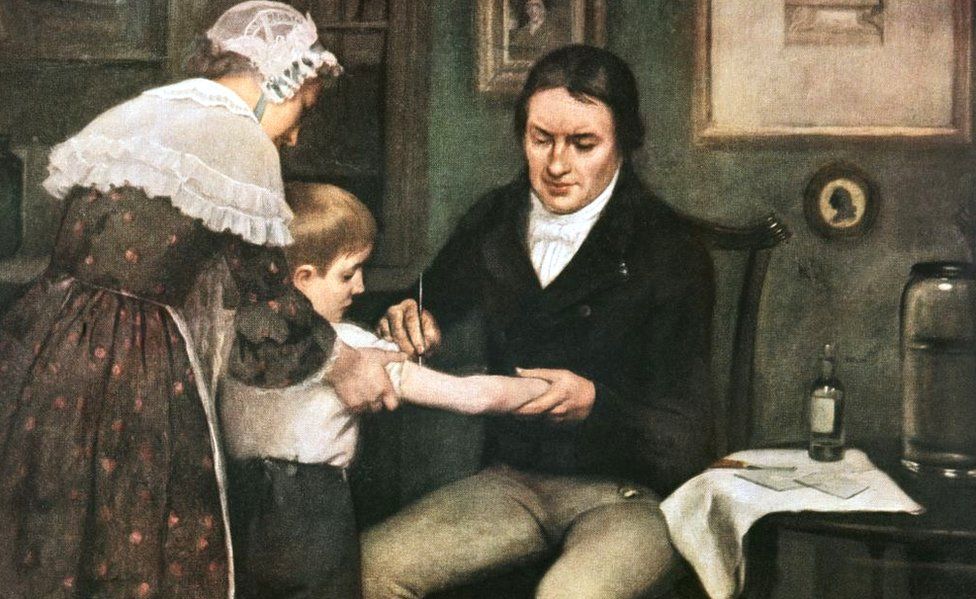
In order to give the immune system the memory it needs to fight smallpox once it enters the body, the doctor came up with the brilliant idea of infecting his patients with cowpox, which is contagious but much less dangerous than what smallpox can do to a human. He called this procedure « the variolae vaccine » and performed it on a boy for the first time. In 1796, at that same time, the idea of a modern vaccination was born. The boy lived and showed no signs of smallpox. And Edward Jenner branded himself as « the father of immunology » in history.
From that time until 1850, vaccination evolved, and then the arm-to-arm vaccination practice emerged, posing a safety concern because this new method of immunization allows for the transmission of bacteria and other diseases from one person to another.
Sydney Cooper, a microbiologist, discovered in 1896 that adding glycerin to the blistering agent used during the procedure could make this vaccination safer.
As a result, scientists were able to create the vaccine « dryvax, » which was used in the 1967 big WHO vaccination campaign that was a complete success.
The smallpox was eradicated, and research continued in the years that followed to reduce the vaccine’s side effects and make it more effective.
With knowledge, observation, try and error as well as the absurd notion of a normal girl, which we can term « luck » and the culminated work of many minds, many hands, many hearts during hundreds of years, this holly tool of science was created.
People like us who were born in an era where a new vaccine could be developed in one or one and a half year to stop a worldwide pandemic are unable to appreciate the blessing that this discovery brought to the world.

One of the deadliest diseases in human history, smallpox is believed to have killed hundreds of millions of people throughout history with a death rate of 30%, compared to coronavirus’s 3%, just to imagine the nightmare it caused to humanity; the battle that humans won against it is one of history’s greatest victories.
Granted with hardiness and protection, waiting for the secret work of a needle in their bodies, with calm breaths and relaxed shoulders people received their vaccine.
May humanity always strive in preserving a world rich of life and vitality.

Written By : Nada Arfaoui.

Share your thoughts

Continue Reading

Made with ❤ at INSAT - Copyrights © 2019, Insat Press