
Connect with us

Sciences et technologie

3rd Tunis Big Data Meetup

Avatar

Published

on

[simplicity-save-for-later]

Tunis Big Data Meetup revient, à l’INSAT, lors de la matinée du Samedi 26 novembre, pour sa troisième édition avec de belles lumières reflétées sur les murs de l’auditorium et une musique sympa en background. Ainsi s’était déroulée l’attente qui a duré pendant presque une heure, avant que les visages prometteurs des conférenciers ne se manifestent.

Entre questionnements et silences attentifs, le premier talk a commencé: « Machine Learning : Comment les données nous permettront d’anticiper l’avenir ? » avec Mr Abdelhalim Rafrafi, ingénieur R&D chez Fanvoice et titulaire d’un doctorat en Machine learning à UPMC Paris. Cela nous a fait entrer, tout de suite, dans le grand monde des données. Ce fût une réponse à plusieurs interrogations, mais surtout à celle qui suit : « Pourquoi le machine learning? ». Nous faisant découvrir les chiffres portant sur la quantité de data qu’on possède de nos jours et leur distribution à l’international illustrée sur une carte du monde géopolitique, Mr Rafrafi nous renseigne plus sur le machine learning, les domaines variés de son application et enfin, la manière d’analyser toutes ces données.
 
Après une courte session de Questions Réponses, le deuxième conférencier est chaudement accueilli et Mr Haithem Jarraya, développeur indépendant de logiciels spécialisé dans l’écosystème Big Data, diplômé de l’INSAT et ayant un Master en Science des Statistiques Informatiques et Apprentissage Automatique de l’Université de Londres, fait ses pas vers l’estrade pour nous présenter son propre talk: « Beyond reporting, predictive analytics. » Ou plus précisément, comment le stockage des données est fait? Comment fait-on, plus ou moins, pour exploiter ces données afin de prévoir? Les outils, les étapes, les processus, Mr Jarraya partage avec nous ce domaine qui le passionne avec une invitation à faire connaissance avec le BI : « Business Intelligence ».
Tout mot dit, on fait encore une fois appel à une séance de Questions Réponses à laquelle ont contribué plusieurs intervenants, professionnels et professeurs de l’INSAT, et on clôt ce meetup par un petit mot tandis que les participants sortent un par un pour une pause café.

Share your thoughts

Sciences et technologie

Chapter 2 : England, the Discovery of Vaccines.

insatpress

Published

on

[simplicity-save-for-later]

By

Fast breathing, clenched fists, and hunched shoulders are common signs of tension that most people show as the vaccination syringe approaches the body whilst 300 years ago people took the same syringe with great joy and hope.
The reason is that we are clueless of what humanity endured before the « blessing » of vaccines came to light.
Let me tell you the tale of one of humankind’s greatest inventions through the eyes of a time walker. This invention actually underwent a lengthy process of discovery, development, and improvement that lasted for centuries.

And our wanderer walked down the lane of the 1700s, when English physician Edward Jenner overheard a girl boasting to her friend that she would not contract smallpox because she had already contracted cowpox and she will have a flawless face free from pox blisters.

The doctor thought that the idea was brilliant even though it seemed silly.
Why not provide cowpox vaccination instead of the usual inoculation which involved inserting fresh smallpox material, such as blisters from a sick individual, under the skin of a nonimmune person considering that 3 percent of people died due to variolation using the previous method?
Smallpox and cowpox both belong to the same family « poxviridae » and once the disease is transferred from cows to people, it became weakened
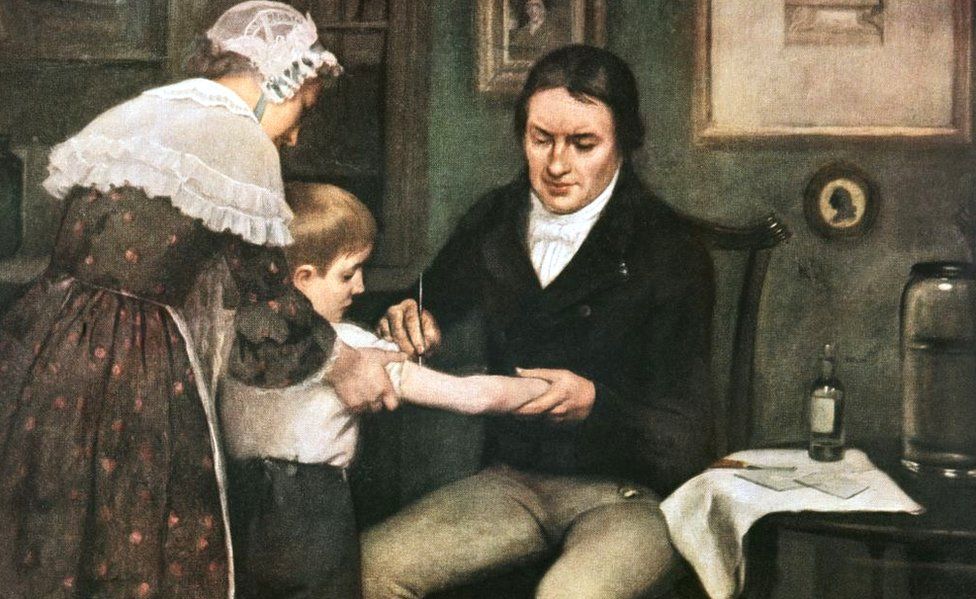
In order to give the immune system the memory it needs to fight smallpox once it enters the body, the doctor came up with the brilliant idea of infecting his patients with cowpox, which is contagious but much less dangerous than what smallpox can do to a human. He called this procedure « the variolae vaccine » and performed it on a boy for the first time. In 1796, at that same time, the idea of a modern vaccination was born. The boy lived and showed no signs of smallpox. And Edward Jenner branded himself as « the father of immunology » in history.
From that time until 1850, vaccination evolved, and then the arm-to-arm vaccination practice emerged, posing a safety concern because this new method of immunization allows for the transmission of bacteria and other diseases from one person to another.
Sydney Cooper, a microbiologist, discovered in 1896 that adding glycerin to the blistering agent used during the procedure could make this vaccination safer.
As a result, scientists were able to create the vaccine « dryvax, » which was used in the 1967 big WHO vaccination campaign that was a complete success.
The smallpox was eradicated, and research continued in the years that followed to reduce the vaccine’s side effects and make it more effective.
With knowledge, observation, try and error as well as the absurd notion of a normal girl, which we can term « luck » and the culminated work of many minds, many hands, many hearts during hundreds of years, this holly tool of science was created.
People like us who were born in an era where a new vaccine could be developed in one or one and a half year to stop a worldwide pandemic are unable to appreciate the blessing that this discovery brought to the world.

One of the deadliest diseases in human history, smallpox is believed to have killed hundreds of millions of people throughout history with a death rate of 30%, compared to coronavirus’s 3%, just to imagine the nightmare it caused to humanity; the battle that humans won against it is one of history’s greatest victories.
Granted with hardiness and protection, waiting for the secret work of a needle in their bodies, with calm breaths and relaxed shoulders people received their vaccine.
May humanity always strive in preserving a world rich of life and vitality.

Written By : Nada Arfaoui.

Share your thoughts

Continue Reading

Made with ❤ at INSAT - Copyrights © 2019, Insat Press